
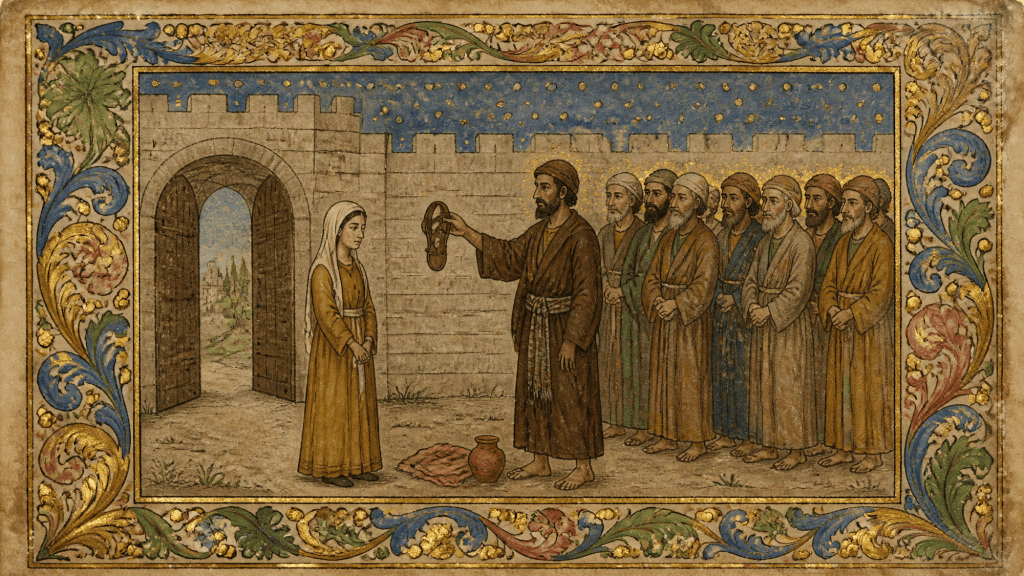
The Bible Never Defines Marriage
There is no wedding ceremony anywhere in Scripture — no vow, no officiant, no words you have to say. So where did we get the blueprint we keep arguing about?
Ask almost anyone what “biblical marriage” means and they will answer without hesitation: one man, one woman, a covenant, a ceremony, a vow before God. It sounds like it’s printed on the first page of the book.
It isn’t. Search the whole Bible, Genesis to Revelation, and you will not find a single wedding ceremony. No vows. No rings. No officiant. No formula of words that makes two people married. When Scripture describes a marriage beginning — even the marriages of its greatest heroes — the language is startlingly flat: he took her, and went in unto her. That’s it. That’s the ceremony.
What follows is not an attack on marriage. It’s an honest look at what the text actually says, and — just as importantly — what it doesn’t.
There Is No Word for the Thing We’re Arguing About
In biblical Hebrew, the word for “woman” and the word for “wife” are the same word: ishshah. In Greek, it’s gynē. The original languages don’t carry the distinction our English translations quietly insert for us. The text has no separate vocabulary for the status we treat as a foundation stone of civilization.
And notice the recurring formula. It is never “he married her.” It is “he took a wife.”
“And Lamech took unto him two wives: the name of the one was Adah, and the name of the other Zillah.”
— Genesis 4:19 (KJV)
“And Amram took him Jochebed his father’s sister to wife; and she bare him Aaron and Moses.”
— Exodus 6:20 (KJV)
Hold that second one. That is Moses’ own mother and father. His mother was his father’s aunt — and the text states it as a simple fact of genealogy, in the middle of a list, with the same tone it uses for ages and place names. No scandal, no editorial shudder, no caveat.
If the Bible were the marriage manual we treat it as, this would be the strangest possible place for silence.
The First Polygamist, and the Silence That Follows
The first man in Scripture to take two wives is Lamech, seventh generation from Adam. The text hands us the arrangement without a syllable of judgment attached to the number: “And Lamech took unto him two wives” (Genesis 4:19).
Lamech is not presented as a hero — his boast of vengeance a few verses later is ugly. But that is the point. The narrator is perfectly willing to condemn Lamech for other things, and never once for having two wives. The silence is not an oversight. It is the absence of a rule.
From there, the pattern is not the exception. It is the rule.
- Elkanah, father of the prophet Samuel: “And he had two wives; the name of the one was Hannah, and the name of the other Peninnah” (1 Samuel 1:2). The whole opening of 1 Samuel turns on this household — and the fault lines the narrator cares about are jealousy and grief, not arithmetic.
- David: “And David took him more concubines and wives out of Jerusalem, after he was come from Hebron” (2 Samuel 5:13).
- Solomon: “And he had seven hundred wives, princesses, and three hundred concubines: and his wives turned away his heart” (1 Kings 11:3). Read the charge carefully. It is not the seven hundred. It is the turning away of the heart.
- And most striking of all — 2 Chronicles 24:3, where the faithful priest Jehoiada arranges a two-wife marriage for the young king Joash, and the Chronicler records it without a word of criticism: “And Jehoiada took for him two wives; and he begat sons and daughters” (2 Chronicles 24:3).
A priest. Acting on behalf of a reforming king. Recorded as unremarkable.
The Law Doesn’t Ban It. It Regulates It.
This is where the argument usually turns, and where the text is least ambiguous.
If monogamy were the divinely fixed definition of marriage, the Law of Moses would say so in one line. Here is what it says instead:
“If a man have two wives, one beloved, and another hated, and they have born him children, both the beloved and the hated…”
— Deuteronomy 21:15 (KJV)
That is not a prohibition. It is an inheritance clause about which son gets the birthright. The Law assumes the situation and legislates fairness inside it.
“If he take him another wife; her food, her raiment, and her duty of marriage, shall he not diminish.”
— Exodus 21:10 (KJV)
That is a protection clause for the first wife: she does not lose her food, her clothing, or her marital rights because a second woman arrived. You only need fire codes for buildings that are allowed to be built.
And then this, which closes the question:
“Neither shalt thou take a wife to her sister, to vex her, to uncover her nakedness, beside the other in her life time.”
— Leviticus 18:18 (KJV)
The verse forbids marrying two sisters. It says nothing — here or anywhere in the same chapter — about marrying two unrelated women. The prohibition only makes sense if the second practice was assumed.
God Says He Handed Over the Wives
Here is the sentence that should stop the conversation. It is not an obscure verse. It is Nathan’s indictment of David, in the most famous confrontation in the Old Testament, and it comes directly from the mouth of God:
“I gave thee thy master’s wives into thy bosom, and if that had been too little, I would moreover have given unto thee such and such things.”
— 2 Samuel 12:8 (KJV)
God describes himself as the one who gave David another man’s wives — and states that the problem was not the wives, because he would gladly have given more. The sin being judged in 2 Samuel 12 is Uriah, and Bathsheba, and a life taken to hide it. Not the number.
Whatever you conclude from that verse, you cannot conclude that Scripture treats plurality itself as the forbidden thing.
Brothers and Sisters, Without a Flinch
The patriarchs married within their own father’s house, and the text states it plainly.
“she is the daughter of my father, but not the daughter of my mother; and she became my wife”
— Genesis 20:12 (KJV)
That is Abraham — the father of faith, the man God called and covenanted with — explaining to a foreign king that Sarah is his half-sister. The story rebukes him sharply for lying about it. It never once rebukes him for the marriage. It is treated as a fact of the household he came from, not a sin to be repented of.
And centuries later, a daughter of David treats that same possibility as live and reasonable. When Amnon assaults Tamar, her objection is not “that is unthinkable.” It is a request for a different route:
“Now therefore, I pray thee, speak unto the king; for he will not withhold me from thee.”
— 2 Samuel 13:13 (KJV)
She assumes their father would grant her to her half-brother. Nobody in the scene corrects her theology. The horror being narrated is what Amnon does, not who Tamar believed she could be given to.
The Bride Was Property, and the Ceremony Was a Transaction
When the text does show a marriage being assembled, the shape of it is unmistakable.
“then the man that lay with her shall give unto the damsel’s father fifty shekels of silver, and she shall be his wife”
— Deuteronomy 22:28–29 (KJV)
The bride’s consent is never asked for. The coin changes hands, and the marriage exists. Elsewhere she is simply transferred — Sarai takes her own servant and “gave her to her husband Abram to be his wife” (Genesis 16:3); Rachel does the same with Bilhah: “And she gave him Bilhah her handmaid to wife: and Jacob went in unto her” (Genesis 30:4). Two marriages created by two wives, with no ceremony, no vow, and no court.
And here is a wedding from beginning to end — the entire liturgy of it:
“And it came to pass in the evening, that he took Leah his daughter, and brought her to him; and he went in unto her.”
— Genesis 29:23 (KJV)
A father takes his daughter and brings her to a man’s tent. That is the whole ceremony. And this was the birth of the twelve tribes of Israel.
If your wedding took more than one sentence, you borrowed every word of it from somewhere other than Scripture.
The Honest Objections, and What They Actually Say
None of this is a secret. The verses that feel most like counterarguments are, on inspection, the strongest evidence that no definition exists.
“But Genesis 2:24 defines marriage.”
“Therefore shall a man leave his father and his mother, and shall cleave unto his wife: and they shall be one flesh.”
— Genesis 2:24 (KJV)
This is the closest the Bible comes to a definition, and it is worth noticing what kind of sentence it is: an observation by the narrator about what happens, not a statute commanding what must happen. No vow, no witness, no requirement, no words to say. It is a description of the design — and it is beautiful, and it is true, and it is not a definition of who may and may not be married.
“But Jesus settles it.”
He does something more interesting than settle it:
“Moses because of the hardness of your hearts suffered you to put away your wives: but from the beginning it was not so.”
— Matthew 19:8 (KJV)
Christ himself distinguishes between the ideal at the beginning and what Moses permitted in the middle — and he calls the permission an accommodation for hard hearts. Even Jesus, quoting Genesis 2:24, treats the standard as aspirational and the law as a concession. If the Son of God frames the Old Testament’s marriage legislation as accommodating rather than definitive, the rest of us might hold our certainty more lightly.
“But Deuteronomy 17:17 forbids multiplying wives.”
“Neither shall he multiply wives to himself, that his heart turn not away”
— Deuteronomy 17:17 (KJV)
True — and note the scope. That is a restriction on kings, in a passage that in the same breath restricts multiplying silver, gold, and horses. It is a warning about royal excess and a wandering heart, not a definition of marriage for anybody else. No penalty is attached. And the kings did it anyway, with a prophet sometimes in the room.
“But 1 Timothy 3:2 says ‘the husband of one wife.’”
“A bishop then must be blameless, the husband of one wife.”
— 1 Timothy 3:2 (KJV)
Exactly — and read what that is. It is an office qualification for overseers, in a letter about church order. Rules of that kind exist precisely because the surrounding situation was more permissive than the rule. If monogamy were already the unquestioned definition of marriage, the requirement would be redundant.
“But Malachi calls marriage a covenant.”
“the wife of thy covenant”
— Malachi 2:14 (KJV)
This is the best biblical language for marriage in the entire Old Testament, and it’s genuinely important. But note that the covenant there is invoked to condemn treachery against a spouse already married — it is an argument about faithfulness, not a definition of who may marry or how many. Scripture gives you the moral weight of marriage in full. It never gives you the shape.
“But Leviticus 18:18 could mean two wives at all. Some Hebrew margins render it “one wife to another,” which would make it a general ban on polygamy. Fair — it’s a real textual question, and honest readers differ. But even on that reading you are left with one implied prohibition in one verse, surrounded by laws that assume and regulate the practice everywhere else. A prohibition from silence is a weak foundation for a doctrine of definition.
The One Place This Argument Gets Overstated — and Why I Won’t Do It
There is a version of this talking point that says the Bible shows father–daughter marriage. It doesn’t, and pressing it would sink everything else in this post. Here is what the text actually gives you:
“Come, let us make our father drink wine, and we will lie with him…”
— Genesis 19:32 (KJV)
Lot’s daughters get their father drunk and lie with him to preserve the family line. This is a narrative of incest by deception. The Bible does not call it marriage, does not bless it, and the men born of it — Moab and Ammon — become Israel’s enemies. Anyone using this as a proof text is reading it against its own grain.
But notice what is nevertheless true, and it is just as damning to the “clear biblical definition” claim: at this point in the story there is no law to break. No commandment forbids it yet. No prophet thunders. No fire falls. The narrator simply records it. In a book where a man dies for touching a holy object, this passes unjudged — because the statute book hasn’t been written. The moral horror arrives later, in Leviticus:
“And if a man shall take his sister, his father’s daughter, or his mother’s daughter… it is a wicked thing.”
— Leviticus 20:17 (KJV)
“Cursed be he that lieth with his sister, the daughter of his father, or the daughter of his mother.”
— Deuteronomy 27:22 (KJV)
Which is precisely the point. The Bible’s sexual ethics are not a single eternal template delivered once and for all. They are a record of moral development — law arriving late, accommodation granted for hard hearts, ideal held out and never fully reached. That is a far more defensible claim than pretending Scripture says something it doesn’t.
What All of This Actually Means
So let’s be plain about the conclusion, because it is not the one either side usually wants.
The Bible never defines marriage. It has no ceremony, no vow, no officiant, and no word that means only “wife.” What it has is a record: people reaching for each other across thousands of years, under laws written for hardness of heart, in a world where a woman could be given, purchased, inherited, or sent away with a document — “When a man hath taken a wife, and married her… bill of divorcement” (Deuteronomy 24:1).
That record contains real moral weight. It contains covenant, faithfulness, and the awful grief of betrayal. It also contains things we would never sanction now, presented without comment. And it contains one sentence from the mouth of God that we would rather skip past: I gave thee thy master’s wives into thy bosom, and if that had been too little, I would moreover have given unto thee such and such things.
The text is not a blueprint. It is a mirror — held up to people doing their best with what they had, in a world nothing like ours, and it trusts you to notice the difference between what was permitted and what was good.
Which means the question was never “what does the Bible say marriage is.” Scripture doesn’t answer that question. It hands it back to you.
And the honest follow-up is harder than any proof text: not what does the book permit me to do, but what am I building with the person in front of me — and does it deserve the name?
That question has no verse for an answer. It never did.


Leave a Reply