
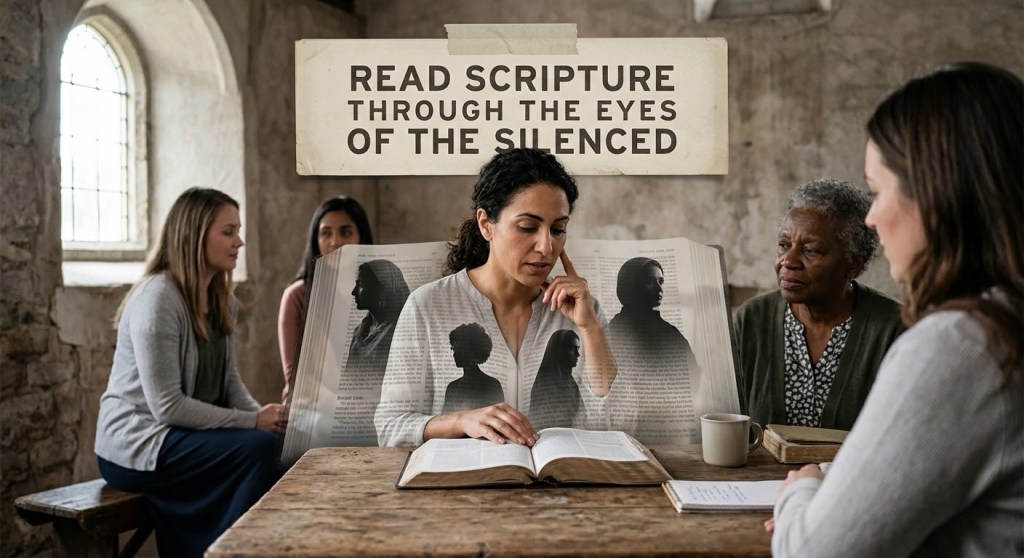
For generations, most of us were taught to read the Bible through a single, dominant lens. We were trained to identify with the kings, the generals, the apostles, and the architects of religious institutions. We traced the grand arcs of empires, battle victories, and royal lineages.
But when you read Scripture strictly through the gaze of power, you miss half the story—and arguably, the very heart of the gospel.
What happens when you stop reading the Bible through the eyes of the conquerors and start reading it through the eyes of the silenced? The narrative shifts dramatically. The moral centers relocate. And a God who looks remarkably different from human authority begins to emerge.
Read as Hagar: The God Who Sees the Cast Aside
When traditional teaching covers the story of Abraham and Sarah, Hagar is often reduced to a footnote—a temporary “mistake” or a tool used to fulfill a divine promise.
Now, read as Hagar.
You are an enslaved Egyptian woman with no control over your own body. You are used to produce an heir, and when conflict arises, you are driven out into a lethal desert with a dying child and an empty water skin. Yet, in that desolate wilderness, God does not address you as a piece of property or an inconvenient statistic. God meets you face-to-face, providing water and dignity. Hagar becomes the only person in the entire Hebrew Bible to give God a personal name: El Roi—“The God Who Sees Me.”
Reading as Hagar reminds us that God’s primary locus of care is often outside the tents of the powerful.
Read as Vashti: The Unyielding Dignity of Rejection
In the opening chapter of the Book of Esther, Queen Vashti is usually framed as a minor obstacle—the proud woman whose downfall makes room for Esther’s rise.
Now, read as Vashti.
You are summoned by a intoxicated king and his court of grandstanding nobles to be paraded as a sexualized trophy. In a culture where defying the monarch means exile or death, you say no. You refuse to let your humanity be reduced to imperial entertainment. Vashti’s refusal is not a moral failure; it is a profound declaration of self-worth.
Reading as Vashti teaches us that personal integrity and bodily autonomy exist long before systems of authority choose to recognize them.
Read as the Woman with the Issue of Blood: Overturning Ritual Isolation
In the Gospels, the story of the woman who touches the fringe of Jesus’ garment is often framed simply as a miraculous healing demonstration.
Now, read from her perspective.
You have suffered continuous bleeding for twelve years. Under the social and religious laws of your time, you are perpetually “unclean.” Every bench you sit on, every person you touch, becomes symbolically defiled. You have spent every penny you owned on doctors who only made it worse. You are economically drained, physically exhausted, and socially erased.
When she reaches out in the crowd, she isn’t just seeking physical relief; she is committing a daring act of civil and religious disobedience. And when Jesus stops, he doesn’t scold her for contaminating him. He calls her “Daughter,” restoring both her health and her place in the community.
Reading as this woman shows us a Jesus who refuses to let human purity codes dictate who deserves touch and belonging.
Read as Rizpah: Love Standing Against Royal Brutality
Tucked away in the shadow of King David’s reign is one of the most heartbreaking acts of protest in ancient literature (2 Samuel 21). David hands over seven descendants of Saul to be executed to settle a political debt, leaving their bodies exposed on a mountain.
Now, read as Rizpah.
Two of those young men are your sons. In the ancient world, leaving corpses exposed to decay and be eaten by animals was the ultimate indignity. Rizpah does not have an army or a political platform. So she takes sackcloth, spreads it on a rock near the bodies, and stays there—day and night, through the harvest season until the rains come—fighting off birds by day and wild beasts by night.
Her quiet, relentless grief shames the crown. Eventually, news of her vigil reaches David, forcing him to give her sons a proper, dignified burial.
Reading as Rizpah reveals the power of righteous grief—a mother’s love confronting the cold calculus of state violence.
Reclaiming the Lens
When we shift our perspective from the palace balconies to the dusty roads, the wildernesses, and the fringes of the crowd, the Bible ceases to be a handbook for justifying authority. It becomes what it was always meant to be: a living testament to a God who continually side-steps the powerful to stand alongside the vulnerable, the blamed, and the broken.
Next time you open Scripture, ask yourself: Whose voice is being left out of this sermon? And what happens if I read this story through their eyes?


Leave a Reply