
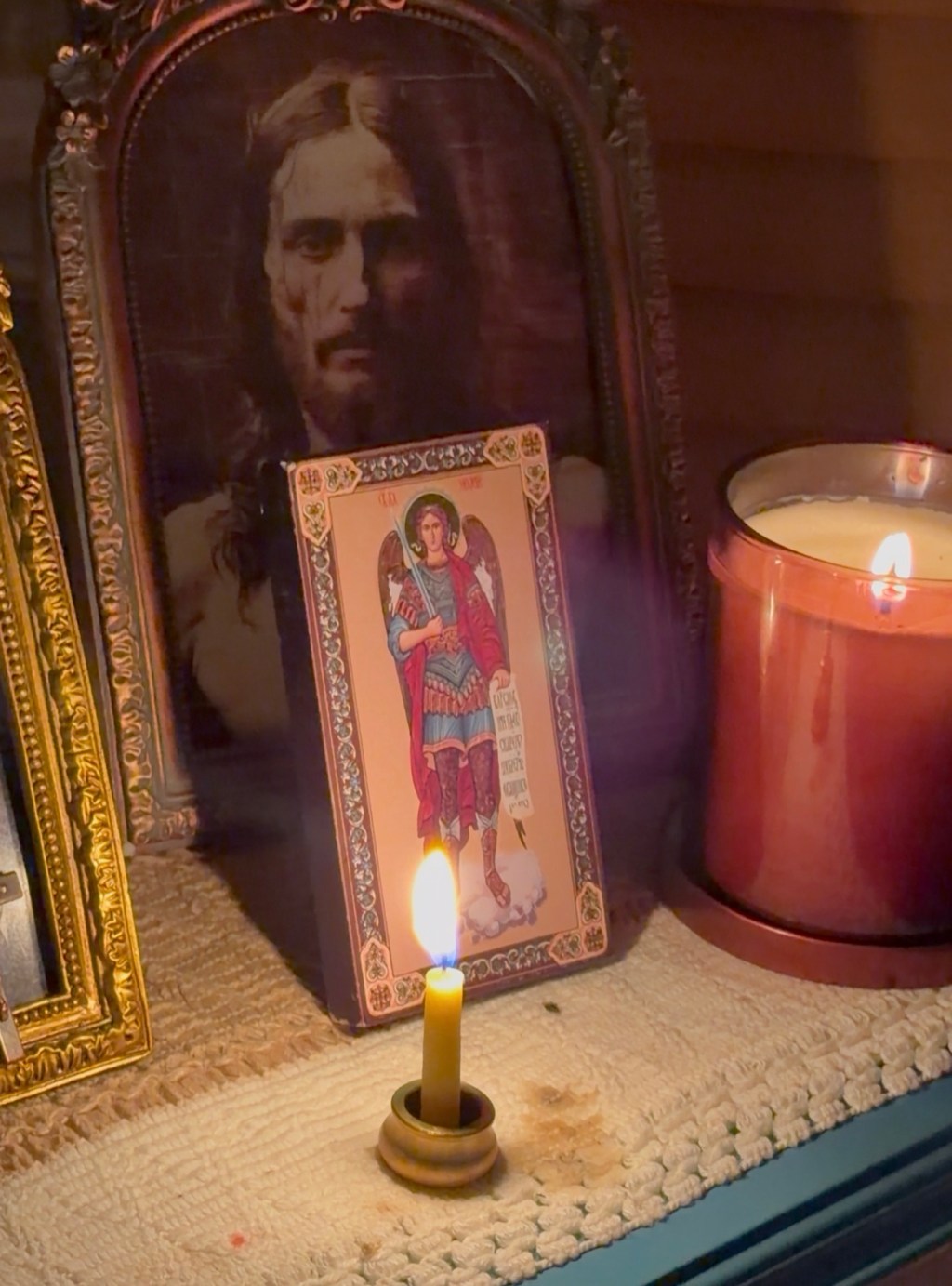
The Absorption
Imagine a movement that has already changed the world. Not a think tank, not a party, not a candidate — a spiritual movement. Millions of people, a moral vocabulary that reaches into ordinary speech, a promise about who is actually in charge of history. It exists before any administration touches it. It has survived being ignored, mocked, and worse.
Imagine an administration deciding not to fight it — but to take it.
Not suppress it. Absorb it. Give it an office inside the White House and staff it. Give it a task force to hunt its enemies. Give it a commission to redraw the wall that was built to keep it at a distance. Let its vocabulary become the state’s vocabulary, until the thing that once stood outside power is sitting in the room where power is decided.
Imagine that. Now hold it, because it’s not a hypothetical.
What the paperwork actually says
On February 7, 2025, Executive Order 14205 established the White House Faith Office — not as an advisory gesture, but as an office seated inside the Executive Office of the President, given “lead responsibility” across the executive branch to empower faith-based entities Federal Register. It was placed under Paula White-Cain, a prosperity-gospel televangelist whose public theology ties divine favor to financial giving Christianity Today.
One day earlier, February 6, 2025, Executive Order 14202 — “Eradicating Anti-Christian Bias” — created a presidential task force to investigate discrimination against a single faith inside the federal government, with the Attorney General as its chair White House. The task force has since published a report on its findings DOJ.
Then came the commission. Ordered May 1, 2025, chaired by Texas Lieutenant Governor Dan Patrick, who has said publicly that the separation of church and state is a lie Texas Monthly. When its draft report was delivered, the recommendation was not reform of the doctrine but replacement of it — swap “separation” out, put “bridges” in NBC News, PBS NewsHour.
Three instruments in under a year: an office to house it, a task force to defend it, a commission to redraw the line around it. Read in sequence, they are not three separate policies. They are one motion.
That motion has a first edition.
313
An empire stops executing a movement and starts sponsoring it. The Edict of Milan grants Christians legal standing — the right to organize, the return of confiscated property Britannica, Fordham.
And note the timing, because this is the detail that makes the whole argument. Coins minted under Constantine from roughly 312 to 315 still read SOLI INVICTO COMITI — “to the Unconquered Sun, his companion.” The emperor presents himself as the sun god’s intimate, years after the traditional date of his conversion British Museum.
He did not abandon his own sacred language. He simply added theirs. The state did not convert. The state acquired.
325
An emperor — not a bishop — convenes the bishops. What comes out of Nicaea is a creed containing a word found nowhere in scripture: homoousios, “of the same essence.” The question is settled by a term the movement’s own texts never used. And the losing party’s leader, Arius, is exiled by the emperor Britannica, GOARCH.
That is the hinge. A philosophical proposition becomes a loyalty test. The enforcement mechanism is not argument. It is banishment.
380 – 438
The Edict of Thessalonica, February 27, 380, makes Nicene Christianity the sole religion of the empire and opens the way to repression of those it labels heretics Wikipedia, History Today. The next year, a second emperor convenes a second council to finish the creed Wikipedia. By 438, the Theodosian Code has compiled the law of the empire — and incorrect belief is now a category of crime in the statute book Oregon State.
Toleration to total jurisdiction in one hundred and twenty-five years. Four generations. Long enough for a community to forget it was ever illegal.
And the court theologians did not lag. Eusebius of Caesarea’s Oration in Praise of Constantine — delivered publicly — describes the empire as mirroring the kingdom of heaven, one God in heaven and one emperor on earth, with the emperor as God’s image and heaven’s kingdom his reward Boise State, Cambridge, New Advent. Not a conspiracy theory. A panegyric, given in public, and it worked.
Then the movement’s own institutions finished the job from the inside. In 1534, Parliament declared the king “the only supreme head on earth” of the church UK Parliament. And the papacy’s founding charter for temporal power — the Donation of Constantine — turned out to be a forgery, demonstrated around 1440 by a Catholic priest, Lorenzo Valla, who dated the Latin and proved the “imperial gift” had been written by men who never lived in the empire they claimed to speak for Wikipedia.
A faith about a man the state executed, administered by the state’s successors, on a deed the administrators wrote themselves.
What absorption costs the thing absorbed
This is where the irony stops being clever and starts being an argument.
Athanasius of Alexandria was exiled five times over seventeen years, by four different emperors Wikipedia. He was defending the very creed an emperor had ratified. It didn’t matter. Once the state owns the doctrine, the doctrine becomes a portfolio — and portfolios get rebalanced by whoever holds the office.
The movement’s own founder had been killed by the authority that later claimed to be his vicar. The movement’s own earliest written policy, from Trajan around 112, was don’t go looking for them — punish only those who get named, which is not persecution by ideology but persecution by procedure, a bureaucracy that refuses to investigate and calls that order Georgetown, PBS. Nero blamed them for a fire. Decius ordered them tested. Diocletian ordered their books burned Wikipedia.
All of that, and then the empire that did it started paying the bills.
The tell
There is exactly one moment in this whole record where the machinery ran the other direction. In 390, after troops massacred roughly seven thousand people at Thessalonica, the bishop Ambrose refused the emperor Theodosius entry to the church and required public penance before readmission Wikipedia.
The most powerful man in the world, standing outside a door.
That is what the line of submission looks like when it is real. Not a slogan invoked by power — a rule applied to power. And note what made it possible: a bishop with his own standing, in his own building, with nothing the emperor could take from him that he hadn’t already surrendered.
The line only holds when the man drawing it owes the man crossing it nothing.
Which brings it back to the imagine.
A movement that had already changed the world — absorbed, housed, staffed, defended, and redefined by an administration that did not create it and cannot contain it, in exactly the way an empire absorbed a faith it had once killed and an institution then absorbed the empire back. The names change. The order never does. First the office. Then the definition. Then the code.
It is not a prediction. It is a precedent — and the precedent has a paper trail.


Leave a Reply