
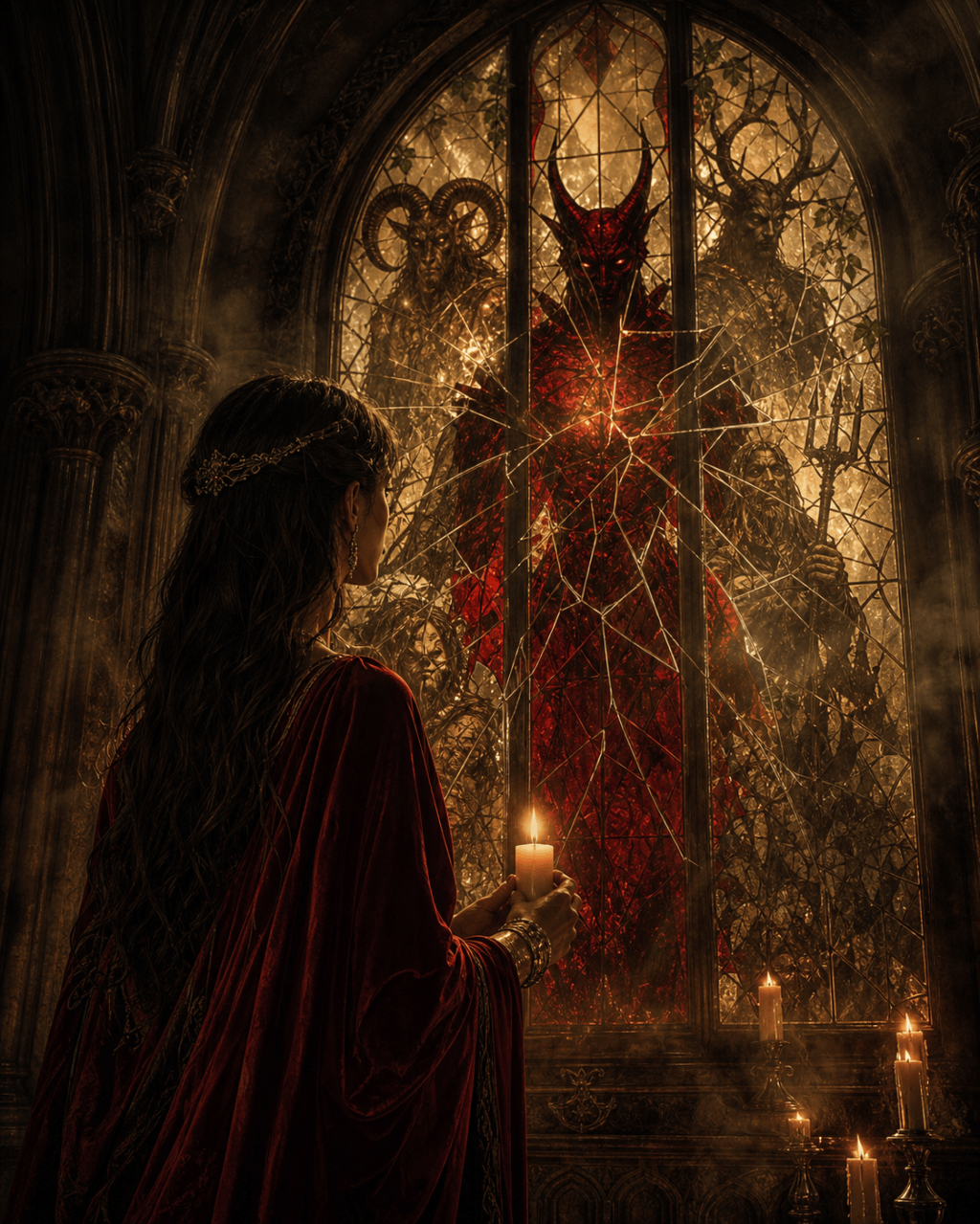
The catchy truth:
“Satan wasn’t revealed — he was marketed. In the Hebrew Bible he’s just ha-satan, ‘the accuser,’ a prosecutor in God’s court. It took Rome, empire, and a thousand years of inquisitors to turn a job title into a horned tyrant — because a Church that could name your enemy could also name your obedience.”
The Facts Behind the Statement
1. In the Hebrew Bible, Satan is a role, not a rival. The word ha-satan (הַשָּׂטָן) means “the adversary” or “the accuser.” In Job, Zechariah, and Numbers, he’s a member of God’s divine council — a prosecutor, not a fallen fugitive. He works for God. There is no rebellion, no Hell, no horns. (Elaine Pagels, The Origin of Satan, 1995.)
2. Persian dualism gave him a costume.
During the Babylonian exile (6th c. BCE), Jews encountered Zoroastrianism and its cosmic war between Ahura Mazda (light) and Angra Mainyu (darkness). That dualism seeped into Second Temple apocalyptic texts (Enoch, Jubilees, the Dead Sea Scrolls) — and ha-satan began mutating from prosecutor to cosmic enemy.
3. Early Christians weaponized him against rivals.
As Pagels documents, the Gospels increasingly cast opponents — Jews, Romans, “heretics” — as agents of Satan. The Devil became a rhetorical brand for whoever the movement needed to defeat. This is where “the accuser” flips into “the enemy of the faithful.”
4. The Church stitched him together from pagan gods.
The visual Satan — horns, hooves, tail, pitchfork — is not biblical. He was assembled from:
Pan (Greek) — horns, goat legs, wild sexuality
Cernunnos (Celtic) — horned forest godHades/Pluto (Greco-Roman) — ruler of the underworld, bident/pitchfork
Dionysus — ecstatic, feared, “dangerous”
Every pagan deity the Church wanted to erase got reabsorbed as a face of the Devil. (Jeffrey Burton Russell, Lucifer: The Devil in the Middle Ages, 1984.)
5. Hell as we picture it is medieval, not biblical.
The lake-of-fire, torture-chamber Hell was largely codified between the 6th and 14th centuries — Augustine systematizing it, Gregory the Great popularizing it, Dante illustrating it in the Inferno (1320). Before that, “Sheol” and “Hades” were just shadowy places of the dead — morally neutral.
Why the Church Needed Him: Fear as an Instrument of Power
The Devil didn’t just appear in Church doctrine — he was useful. A centralized institution ruling over illiterate populations across Europe needed leverage that transcended kings, borders, and languages. Fear of eternal torment was that leverage.
1. Fear made the sacraments non-negotiable.
If Hell is real and eternal, and only the Church holds the keys (baptism, confession, last rites, the Eucharist), then leaving the Church isn’t disagreement — it’s damnation. Salvation became a subscription, and the Church was the sole provider.
2. The Devil justified persecution.
The Inquisition (peaking 1450–1750, ~40,000–60,000 executed, mostly women), and the Crusades all ran on the same engine: the enemy is not human — he is Satan’s agent. The Malleus Maleficarum (1487) codified this into a manual. Once you’ve labeled someone demonic, torture and execution become holy work.
3. Indulgences monetized the fear.
By the late medieval period, the Church was literally selling reduced sentences in Purgatory. Johann Tetzel’s slogan — “As soon as the coin in the coffer rings, the soul from Purgatory springs” — was the logical endpoint. Fear built cathedrals. Fear funded Rome. It also cracked the Church in half when Luther nailed his 95 Theses in 1517.4. Dissent became “diabolical.”
Cathars, Waldensians, Lollards, Hussites, later Protestants — every reform movement was branded satanic before it was crushed. Naming your opponent as the Devil’s tool is the oldest political technology in Christendom.5. Fear disciplined daily life.
Sexuality, women’s autonomy, childbirth, dreams, medicine, herbalism, joy itself — all were policed under the threat that the Devil was always watching, always waiting. The Devil was the surveillance state before there was one.The Bottom Line”The Bible gave the Church a prosecutor. The Church gave the world a monster. Because a God who loves you buys you devotion — but a Devil who hunts you buys you obedience. Satan wasn’t the Church’s enemy. He was its most effective employee.”
Elaine Pagels, The Origin of Satan (Random House, 1995)
Jeffrey Burton Russell, The Devil / Satan / Lucifer / Mephistopheles (Cornell UP, 1977–1986)
Henry Ansgar Kelly, Satan: A Biography (Cambridge UP, 2006)
Bart D. Ehrman, Heaven and Hell: A History of the Afterlife (Simon & Schuster, 2020)
Norman Cohn, Europe’s Inner Demons (1975)
 The Realistic Spiritualist
Leave a comment