

How God’s Partner Got Buried in Translation — and Why She Never Really Left
There’s a story most churchgoers have never heard, and it doesn’t come from a conspiracy book or a late-night internet rabbit hole. It comes from the dirt. Literally — from pottery shards and tomb walls dug out of the ground in the Sinai desert.
In the 1970s, archaeologists excavating a site called Kuntillet Ajrud — an ancient way station in the desert, dated to around 800 BCE — found inscriptions written by ordinary Hebrew people. Not priests. Not kings. Just travelers leaving blessings on storage jars and plaster walls. And the blessing they wrote went something like this:”I bless you by YHWH… and by his Asherah.”His Asherah. God’s Asherah.
Read that again slowly, because it’s one of those sentences that quietly rearranges everything you thought you knew.
She Was Never a SecretHere’s the thing that surprises people most: Asherah isn’t hidden. She was never removed from the Bible. She’s mentioned by name around forty times in the Hebrew scriptures. She stood in the temple. Kings either honored her or tore down her symbols, depending on which way the political wind was blowing. The prophets raged against her worship — and you only rage against something people are actually doing.
In the ancient world, Asherah was a mother goddess, a consort, a queen of heaven. She was represented by a sacred tree or a carved wooden pole — a living symbol of nourishment, fertility, and wisdom. People kept her image in their homes. They baked cakes for her (Jeremiah 7:18, if you want to look it up — the “Queen of Heaven” passage that Sunday school teachers tend to skip).
The early Hebrews didn’t experience God as a lonely bachelor on a throne. For centuries, the divine had a household. A partner. A mother. The sacred wasn’t just masculine sky-and-thunder — it was also tree-and-bread, womb-and-wisdom.Then something shifted.
The Slow ErasureThe reforms came in waves. Kings like Hezekiah and Josiah centralized worship in Jerusalem, tore down the high places, cut down the Asherah poles, and burned the carved images. The Deuteronomists — the editors and compilers who shaped so much of what became the Hebrew Bible — rewrote the story with one God, one temple, one priesthood. Male. Singular. Uncontested.
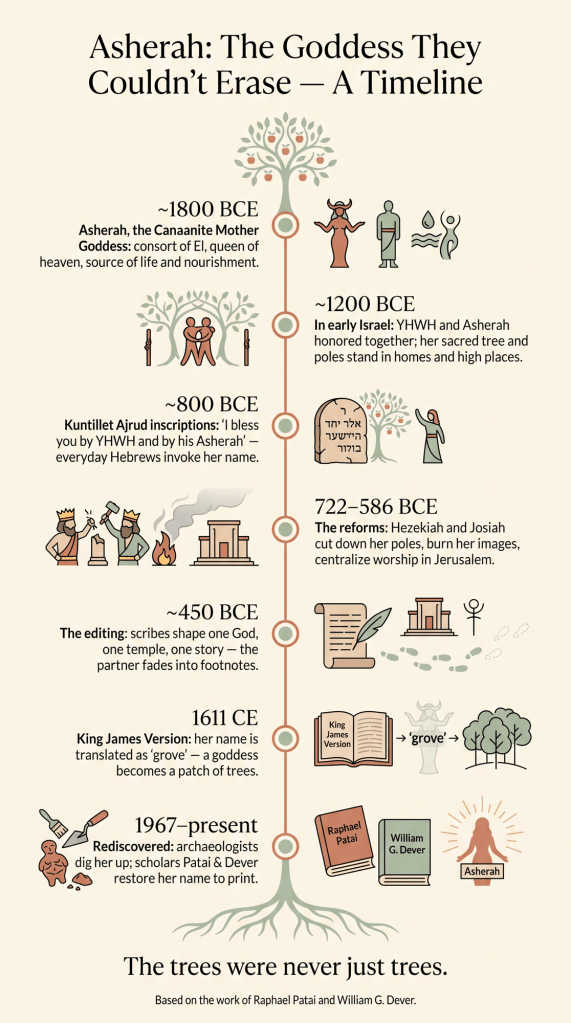
And by the time the Bible crossed into English, the erasure had become so complete it didn’t even require censorship anymore. Just translation.Look at the King James Version. Where the Hebrew text says Asherah — her actual name — the KJV translators rendered it as “grove.” Just trees. Just a patch of woods. 2 Kings 21:7 doesn’t tell you that King Manasseh set up an image of Asherah in the temple; it tells you he put “a graven image of the grove” there. Which makes no sense at all — nobody worships a grove of trees as a carved statue — unless you understand what’s underneath the English.
A goddess, turned into shrubbery.
Nobody had to burn her books. They just changed her name until nobody remembered it was a name.
The Pattern Nobody Talks About
And this is where the story stops being about ancient Israel and starts being about something much bigger.
Watch the pattern across the ancient world: as human societies shifted — as land became property, as lineage started running through fathers, as men consolidated authority over the earth — the goddesses didn’t get defeated in battle. They got demoted. Married off and then widowed. Turned into demons (hello, Lilith). Turned into saints. Turned into symbols. Turned into groves.
Inanna became Ishtar became Astarte became a footnote. The Queen of Heaven became “idolatry.” Wisdom herself — Sophia in Greek, Chokmah in Hebrew, a distinctly female figure in Proverbs who was there “from the beginning” — got quietly folded into the background or rebranded as an abstract concept.difference matters. Something that leaves is gone. Something that’s edited out is still there — under the words, between the lines, waiting in the margins for someone to notice the ink doesn’t quite cover her.
Why This Matters Now
I’m not telling you this to shake your faith. I’m telling you this because I spent years inside traditional religion, and I know what it does to a person — especially to women, but honestly to everyone — to inherit a God with no partner, no mother, no feminine face. You end up with half a sacred story and half a human soul trying to live inside it.
When the divine has no wife, the earth has no mother. And a world with no mother gets treated exactly the way you’d expect.textbooks now, in the work of researchers like William Dever and Raphael Patai, in museum collections, in the footnotes of newer Bible translations that finally print “Asherah” instead of “grove.”
Four thousand years of editing, and she’s still readable.
The trees were never just trees. 🌿
Sources & further reading:
The Hebrew Goddess — Raphael PataiDid God Have a Wife? — William G. Dever
Kuntillet Ajrud inscriptions (Israel Museum)
Jeremiah 7:18, Jeremiah 44:17-19, 2 Kings 21 & 23, 1 Kings 15:13
 The Realistic Spiritualist
Leave a comment