
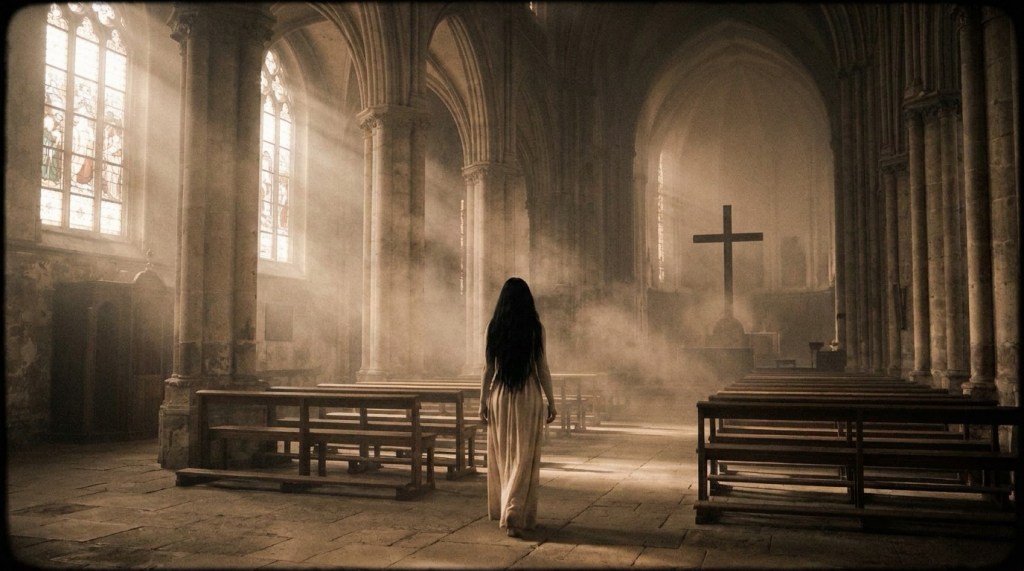
Look at the cross without the centuries of gilding, without the stained glass and the soft hymns, and you see it for what it materially is: an instrument of execution. It was Rome’s electric chair — a wooden device engineered for slow suffocation, public humiliation, and agonizing death. That this object became the central emblem of the world’s largest religion is not a triumph of love over violence; it is a triumph of propaganda over memory. We have been trained to wear a torture device around our necks and call it faith. We hang it in our children’s bedrooms. We tattoo it on our skin. And we rarely ask why the God who supposedly loves us needed his own son nailed to one before he could stand to be in the same room with us.
The doctrine itself is worth saying aloud in plain language: the Christian God — omnipotent, omniscient, the alleged author of every atom — could not, or would not, forgive humanity without first arranging the torture and murder of his own child. He is portrayed as a father who demanded a blood price. And when that blood was spilled, it is said to have “satisfied” him. Any earthly father who operated on this logic would be recognized instantly as a monster. Dressed in incense and Latin, it is called salvation.
Then comes the ritual. Around the age of seven — what the Church itself names the “age of reason,” the precise moment a child becomes capable of consent — Catholic children are gathered in white and taught to eat him. Not symbolically, according to official doctrine, but literally: transubstantiation teaches that the wafer becomes the actual flesh of Christ, and the wine becomes his actual blood. This is ritual cannibalism performed on children at the exact developmental threshold where their consent can be spiritually harvested. It is presented as their first great gift. In any other context, an adult in robes feeding a child human flesh and telling them it will save their soul would be recognized as something else entirely.
Zoom out further and the pattern sharpens. The Abrahamic God does not present himself uniformly to humanity. He gave one law to the Jews, another revelation to the Christians, another to the Muslims — each group told they alone possess the true covenant, each told the others are in error, each promised a special inheritance. And then, predictably, he sits back while these groups slaughter each other in his name. Crusades. Inquisitions. Jihads. Pogroms. Partition. Every generation, fresh rivers of blood spilled by people convinced they are pleasing the same God who, on the other side of the border, is telling their enemies exactly the same thing. A truly loving deity would have corrected the confusion in a single afternoon. This one profits from it.
And that is the tell. Look at what this God consistently requires: worship, fear, obedience, sacrifice, and blood. Look at what he threatens: eternal, unending torture — not for murder or cruelty, but for the crime of not believing in him. Consider what kind of entity would design a system that runs on precisely these two fuels. Worship and fear are among the most concentrated forms of human life-force energy that exist. Blood spilled in someone’s name is the oldest offering in the occult playbook. A being who demands all three, across every continent, for thousands of years, is not a father. It is a farmer. And humanity is the crop.
The trickster fingerprints are everywhere once you learn to see them. Contradictory revelations that ensure permanent conflict. A “loving” God who invented hell. A “merciful” God who required a human sacrifice to feel merciful. A “just” God whose punishments are infinite for finite crimes. A “peaceful” faith whose central icon is a corpse on a torture rack. The cognitive dissonance is not a bug in the theology. It is the mechanism. Confusion, guilt, and terror are what keep the energetic tap open.
None of this means the longing behind religion is false. The human hunger for the sacred is real, ancient, and holy. But the hunger and the thing that has been feeding on the hunger are not the same. It is worth asking, seriously and without flinching, whether the God who demands your son’s blood, your child’s consent, and your enemy’s throat is the source of the light — or something that learned very long ago how to stand in front of it.


Leave a Reply