
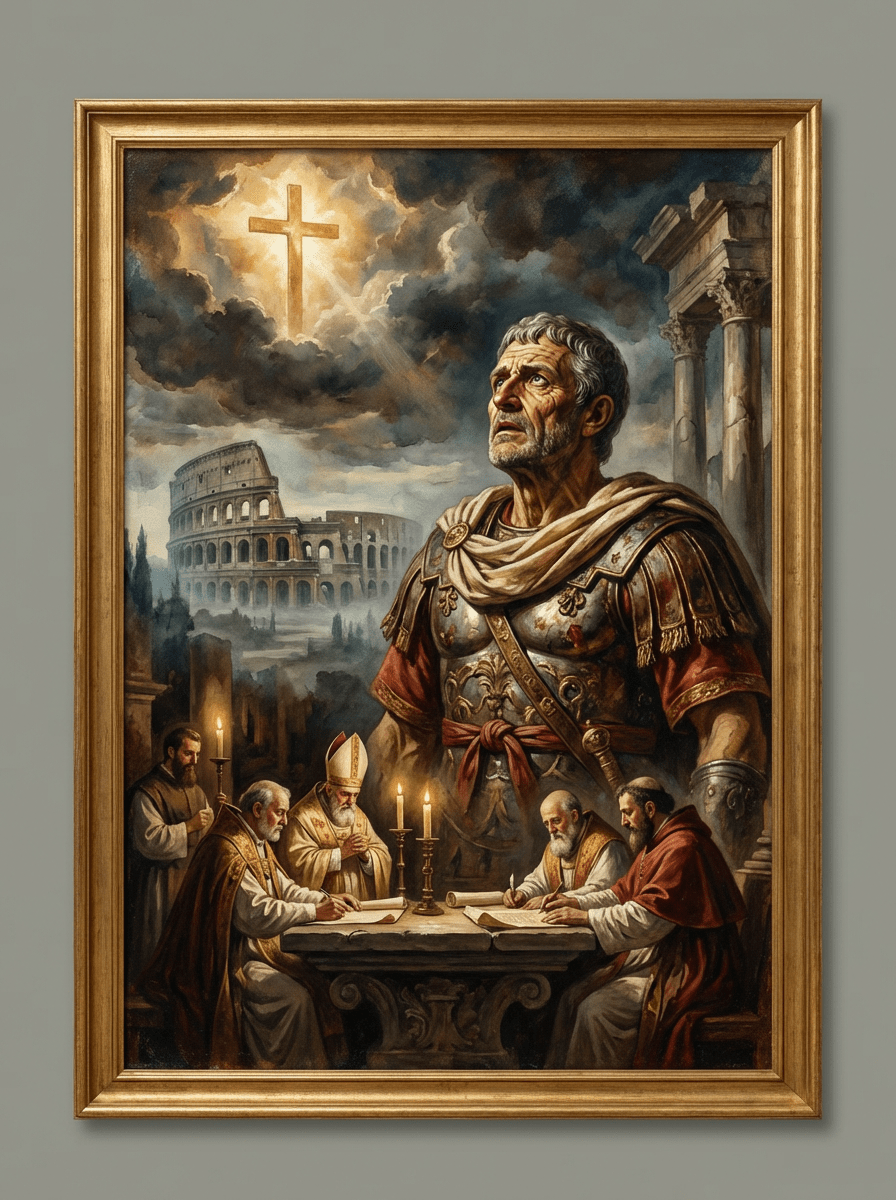
The Empire That Couldn’t Stand Christians
Let’s set the scene. For roughly three centuries, the Roman Empire treated Christians the way a boot treats an ant. Rome was a polytheistic empire — they had gods for everything: war, love, the ocean, the harvest. The emperor himself was considered divine. So when these Christians came along saying “there is only one God, and your emperor is absolutely not one of them” — yeah, that didn’t go over well.
The persecution wasn’t always constant or organized. Early on, it was more regional and reactive — a local governor here, a mob there. But it became increasingly brutal over time. Emperors like Nero (54–68 AD) blamed Christians for the great fire of Rome and had them lit on fire themselves as human torches in his garden. Charming guy. Then came Decius in the 250s, who required every citizen to publicly sacrifice to Roman gods and prove it with a certificate. Christians who refused were tortured or executed.
But the absolute worst? That title goes to Emperor Diocletian.
Diocletian’s “Great Persecution” — The Final Push to Wipe Them Out
In 303 AD, Diocletian launched what historians call the Diocletianic Persecution — the last and most savage state-sponsored assault on Christians in Roman history. Churches were burned to the ground. Scriptures were seized and destroyed. Christian clergy were hunted down, imprisoned, and killed. People lost their jobs, their property, and their legal rights simply for being Christian. Diocletian’s explicit goal, according to historical records, was to completely eradicate the Church. Wikipedia
Think about that for a second. The most powerful empire on earth — with its legions, its wealth, its bureaucracy — had decided Christianity needed to cease to exist. And yet, in less than ten years, that same empire would be signing documents protecting Christians.
So… what in the world happened?
Enter Constantine — The Emperor Who Said He Saw a Sign in the Sky
The short answer is: a man named Flavius Valerius Constantinus happened.
After Diocletian retired (yes, he literally retired — one of the few Roman emperors who didn’t die violently), the empire fractured into a chaotic power struggle between multiple co-emperors. One of those men was Constantine, the son of a Western emperor, who was fighting his way to the top.
On the evening of October 27, 312 AD, Constantine was marching toward Rome to face his rival Maxentius at what would become the Battle of the Milvian Bridge. According to accounts from people who were actually there — most notably the historian Eusebius, who later interviewed Constantine personally — something extraordinary happened. Constantine reportedly saw a vision: a cross of light in the sky with the words “In this sign, conquer” written beneath it (“In Hoc Signo Vinces” in Latin). That night, he supposedly had a dream where Christ appeared to him and told him to put that symbol on his soldiers’ shields. Britannica
Now — was it a genuine divine vision? A solar phenomenon? Propaganda invented after the fact? Historians still debate it. But here’s what nobody debates: Constantine put the Chi-Rho symbol (the first two letters of “Christ” in Greek) on his army’s shields, went into battle, crushed Maxentius — whose forces panicked and many drowned in the Tiber River — and walked into Rome as the undisputed ruler of the Western Empire. Spoken Past
Constantine credited the Christian God for his victory. And that changed everything.
The Edict of Milan — Rome Flips the Script (313 AD)
The very next year, in 313 AD, Constantine and his co-emperor in the East, Licinius, issued the famous Edict of Milan. And this document is a jaw-dropper when you think about the context.
This was the same empire that had been burning churches, seizing Christian texts, and executing bishops — and now it was putting in writing that Christians could freely practice their religion, that any property taken from them had to be returned, and that religious freedom was to be extended to everyone in the empire.
Read that again. The empire that spent three centuries trying to stomp out Christianity just told Christians, “Our bad, here’s your stuff back.” Britannica
Constantine went further than just tolerance. He started funding the building of churches out of the imperial treasury. He gave Christians prominent positions in government. He made Sunday an official day of rest. He gave the Church legal status to own property. He personally got involved in theological disputes — which, as we’ll see, created its own set of problems.
The Council of Nicaea — When the Emperor Called a Meeting About God
By 325 AD, Constantine was having a headache that no emperor had ever had before. The empire was now filled with Christians — but those Christians couldn’t agree on what Christianity actually was.
The biggest fight at the time was over a priest named Arius, who was teaching that Jesus Christ — while holy and the Son of God — was created by God the Father, and therefore was not fully divine in the same way. “There was a time when the Son was not,” was the core of Arius’s teaching. This was called Arianism.
On the other side, Bishop Alexander of Alexandria (and his young secretary, Athanasius) insisted that Jesus was fully and completely God — of the same divine substance as the Father — not a lesser created being.
This wasn’t just a theological Twitter argument. This was splitting the Church, and by extension, Constantine’s newly-Christianized empire. So Constantine did what Roman emperors do — he called a meeting. Wikipedia
In the summer of 325 AD, around 300 bishops gathered at Nicaea (modern-day İznik, Turkey) — summoned from across the empire, with their travel and lodging paid by the emperor himself. Constantine himself opened the council in a golden robe, made a speech about the importance of unity, and largely oversaw the proceedings. This was a government-sponsored theological summit — exactly what you described. A room full of powerful religious leaders, with imperial authority hovering over them, hammering out official positions on what Christianity was.
After heated debate, the council voted to condemn Arianism. The result was the Nicene Creed — a statement of faith that defined Jesus as “true God from true God, begotten not made, of one substance with the Father.” Those exact words were voted on, argued over, and formalized. Arius refused to sign it and was exiled. The council also standardized the date of Easter. Christian History Institute
Here’s an important fact-check though: the Council of Nicaea did NOT decide which books went into the Bible. That’s one of the most widely repeated myths in history, popularized by novels like The Da Vinci Code. The actual discussion about the Biblical canon happened later, at different councils entirely.
From Tolerated to Official — Theodosius Makes It the Law (380 AD)
Constantine made Christianity legal. But it took another emperor to make it the only game in town.
In 380 AD, Emperor Theodosius I issued the Edict of Thessalonica, which declared Nicene Christianity to be the official state religion of the Roman Empire. Not just one religion among many — the religion. Paganism was pushed aside. Other forms of Christianity (like Arianism) were labeled heresy. The old Roman gods, who had been worshipped for over a thousand years, were out. Wikipedia
The empire that had spent 300 years trying to destroy Christianity had now made it mandatory.
So Who Actually Decided What Goes in the Bible?
Now here’s where it gets really interesting — and this is where your instinct about “a room full of people nitpicking books” is actually pretty close to accurate. Just not at Nicaea.
The process of settling the Biblical canon — meaning, the official list of which books belong in the Bible — was a long, messy, and genuinely debated process that unfolded over centuries. Here’s how it actually worked:
For decades and centuries after the first followers of Jesus, hundreds of texts circulated among Christian communities. Some communities used some texts; others used different ones. There was the Gospel of Thomas, the Gospel of Peter, the Gospel of Judas, the Shepherd of Hermas, the Didache, the Epistles of Clement — dozens and dozens of writings that various Christians read, quoted, and debated.
The criteria bishops and scholars used to evaluate texts included:
- Apostolic origin — Was it written by an apostle or a direct companion of one?
- Orthodoxy — Did it align with what had been consistently taught?
- Widespread use — Was it being read across multiple Christian communities, not just one fringe group?
In 367 AD, Bishop Athanasius of Alexandria — the same Athanasius who fought Arius at Nicaea decades earlier — wrote his famous Easter Letter, which is the first known document to list exactly the same 27 books of the New Testament that we have today. Biblica
Then came the councils that formalized it:
- Council of Rome (382 AD) — Produced a list of canonical books
- Council of Hippo (393 AD) — Church leaders met in North Africa and affirmed the canon
- Council of Carthage (397 AD) — This one confirmed the 27 books of the New Testament and the Old Testament list, and restricted the reading of other books in churches Bible Research
So yes — bishops literally sat in rooms, debated which texts were authoritative, and voted to formalize lists. Books like the Gospel of Thomas and the various Gnostic gospels didn’t make the cut — not because Constantine “suppressed” them, but because church leaders across generations concluded they didn’t meet the criteria: they were written too late, didn’t align with apostolic teaching, and weren’t being widely used in mainstream Christian communities.
The Big Picture — A Dying Empire, A Rising Faith
Here’s the thing you have to understand about why all of this happened when it did. The Roman Empire by the 4th century was in serious trouble. It was massive, overextended, economically strained, and constantly dealing with invasions on its borders. It had been splitting into Eastern and Western halves just to be governed at all.
Christianity, by contrast, was growing — and it had something the old Roman religion didn’t: a tightly organized community structure, a strong moral code, charity networks, and people who were loyal to death. You had a religion that even centuries of imperial persecution couldn’t kill. To a politically savvy emperor like Constantine, aligning with that force wasn’t just piety — it was smart governance.
By the time the Western Roman Empire officially fell in 476 AD, the Church had essentially become the backbone of what remained of Roman civilization. The language of the Church was Latin — Rome’s language. The administrative structure of the Church mirrored the empire’s provincial system. Bishops sat in the same cities where Roman governors once ruled. The empire died, but through the Church, Rome never really left. History.com
The Bottom Line
So to sum it all up in plain language: Rome spent 300 years trying to murder Christianity out of existence. Then one emperor saw a sign before a battle, gave Christianity legal protection, and funded its growth. A later emperor made it the mandatory religion of the empire. Meanwhile, bishops — gathering in councils with real political weight behind them — debated, argued, and voted on which texts would form the official Bible. And all of this happened while the empire they were doing it in was crumbling around them.
It’s one of the most stunning reversals in all of human history. The persecutor became the protector. The empire that once threw Christians to the lions ended up putting a cross on its military standards. And a collection of letters, gospels, and prophecies written by fishermen, tent-makers, and wandering preachers got formalized into one of the most influential books in human civilization — not by God descending with a list, but by human beings in rooms, arguing over it, just like you suspected.
History is wild.
Sources: Wikipedia – Constantine the Great | Britannica – Edict of Milan | Wikipedia – First Council of Nicaea | Wikipedia – Christianity as Roman State Religion | Bible Research – Council of Carthage | Biblica – How Books Were Chosen | History.com – 8 Reasons Rome Fell
 The Realistic Spiritualist
Leave a comment